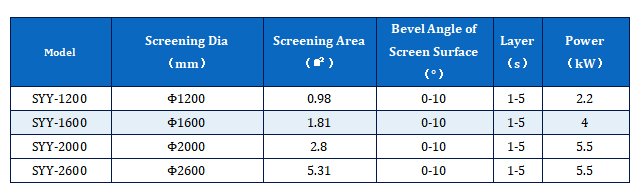
1.Working principle And structure diagram of circular tumbler screen
The design of the circular tumbler screen is a kind of high-efficiency screening machine specially designed to meet the large output and high-precision screening manufacturers. The simpler screening is to screen with both eyes and hands, and the tumbler screen is a mechanical simulation of this. It is currently the most effective simulation of the effective principle of artificial screening movement (the screening accuracy, efficiency, and screen life are 5-10 times that of conventional circular screens), and it meets all fine and ultra-fine ranges of powder and particulate materials. , especially suitable for difficult-to-handle materials.
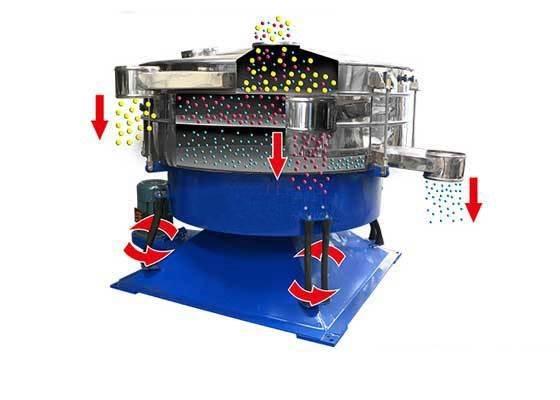
Mainly used for impurity removal and classification of powder, mainly used in metallurgy (non-ferrous metals, non-ferrous metals, magnetic materials, etc.), chemical industry (fertilizer, resin, melamine, soda ash, etc.), food (starch, salt, sugar, milk powder, etc.) .
2.working principle

1). The basic rotation imitates the human manual screening action, the swing amplitude is adjustable from 25-40mm, and the swing frequency is adjustable from 120-360 times/min;
2). The residence time of the screening material in the screen machine can be adjusted by the meridian and cutting angle of the screen machine;
3). The tumbling motion of the material on the mesh surface horizontally and throwing makes the material evenly distributed on the mesh surface from the center to the edge. Thereby propagating in the axial direction in a swirling motion. The fine particles thus complete the entire screening process;
4). The horizontal and vertical acceleration increases with the movement of the particles, and the particles close to the sieve hole are successfully separated. Larger particles are sent to the outlet, where the flow is controlled by an adjustable guide, another factor that controls the residence time of the material;
5). This process is repeated between each sieve layer.